With a typical miner's hashrate set to increase by an order of magnitude or two, increasing pool difficulty - the difficulty at which a share is submitted. This currently set at D = 1 (i.e. 2^32 hashes per share) for many pools possibly creating a network bottleneck if the network hashrate increases a hundredfold as some estimates suggest, and the average pool hashrate remains a constant proportion of the network hashrate.
Increasing the pool difficulty is one answer to this problem. However, increasing pool difficulty will increase variance for all miners. When increasing difficulty the increase in variance for a miner must be taken into account.
1. Variance
The number of shares submitted by a miner with a constant hashrate follows a Poisson distribution. The standard deviation - a measure of how much a variable varies - increases only as the square root of the average number of shares per time period. Thus the more shares submitted in a given time period the lower the variability in shares submitted for that time period. So the lower the difficulty, the lower the variance, and the longer the time period over which the number of shares is assessed, the lower the variance.
For non-PPS pools the variance should not adversely affect miners in the medium term unless the pool difficulty becomes a significant proportion of the bitcoin mining difficulty. However many miners are used to monitoring their software by the minute and may not be able to diagnose problems in their mining rigs if the hashrate produced locally varies significantly from that recorded by the pool.
For PPS pools the variance resulting from varying the pool difficulty will become the only variance a miner will experience, and PPS pool miners not used to variance may not be very comfortable with it at first.
It should be kept in mind that in both these cases, the variation in hashrate averaged over a day is likely to be very low.
Variable pool difficulty is currently implemented in two main ways:
- The difficulty is varied for each miner so that the number of shares a miner submits per minute averages to a particular value. For this method, variance depends only on the number of shares submitted per minute, not the miner hashrate.
- The difficulty at which shares should be submitted is selected by each miner. A miner needs to calculate the difficulty which will result in variance based on the number of shares per time period submitted.
2. Difficulty varies constantly so shares per minute remains constant.
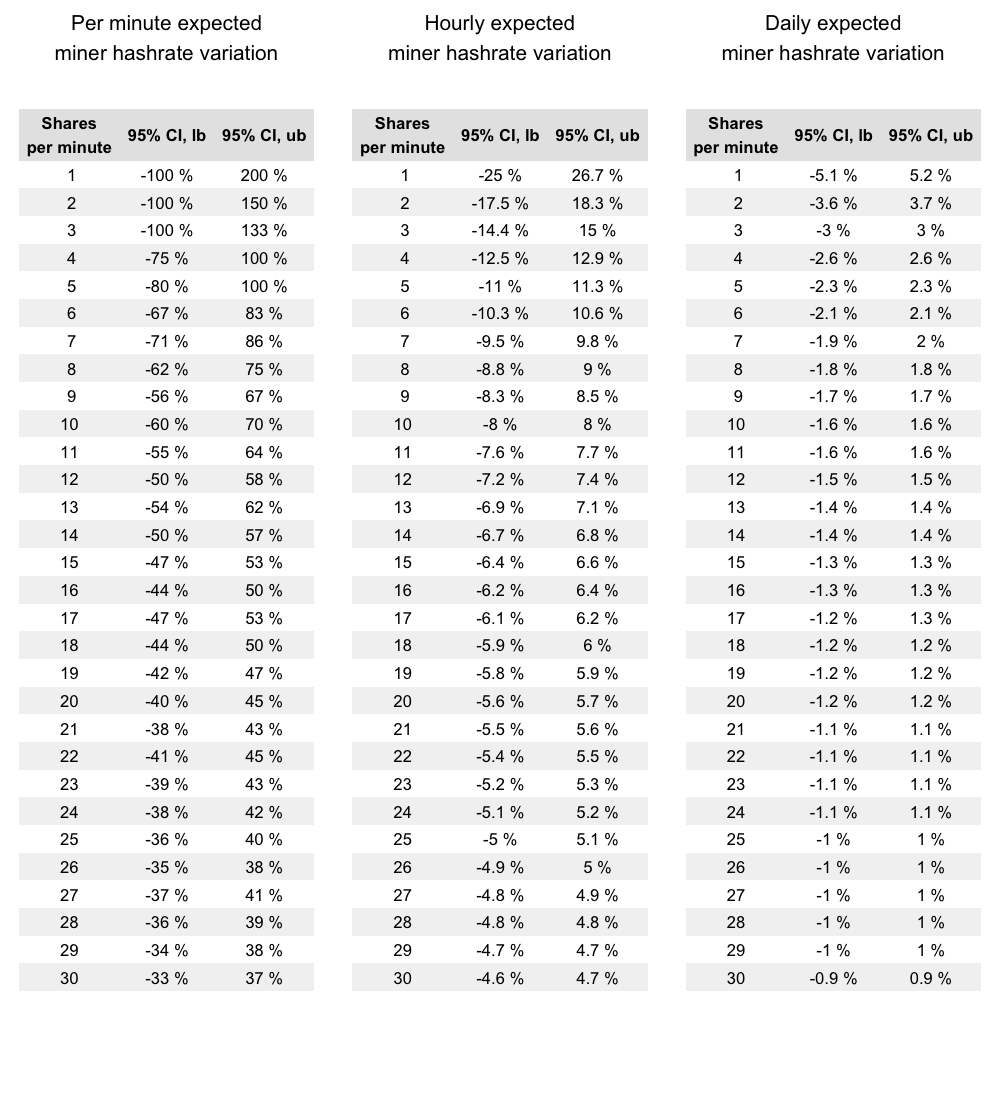
The table and chart below indicates the 95% confidence interval upper and lower bounds ("ub" and "lb") for the expected percentage variation in average miner hashrate. Note that the 95% CI reduces significantly as hashrate is average over longer periods - this means that if you can wait a day the variation in hashrate is much less.
To use the table or chart, pick the number of shares per minute you think you might like to submit and read the upper and lower bounds for the 95% CI percentage variation in hashrate. If you think this is too high or low, pick a smaller or larger number of shares per minute.
The datatable used for the table and chart are at:

3. Miner sets pool difficulty
This becomes a little tricky since there are so many variables. To make it a little simpler than using contour plots, use the table below in conjunction with the tables above. Select your hashrate and a pool difficulty you'd like to check. D=1, D=2 and so on indicate the pool difficulty. The number at the intersection of the two values gives you the expected shares per minute. Then use the table in the section above to find out what the expected average variation in hashrate is.
A worked example:
A miner has 4 Ghps and wants to investigate the effect a pool difficulty of 8 would have on her average hourly hashrate. Reading from the table below she finds that she can expect to submit 6 shares per hour for her hashrate and D = 8.
From the middle table above, she finds that she can expect an ~ 10% variation in average hourly hashrate for D = 8 and 4 Ghps.
A much longer CSV table with many more Ghps values is here: Miner selected difficulty table

4. Conclusions
- Increasing average submitted shares per period only increases the standard deviation in submitted shares per period by the square root of the average submitted shares per period.
- When difficulty varies constantly so shares per minute remains constant, the variation in average hashrate is not dependant on the miner's hashrate, but only on the number of shares per minute.
- When difficulty is selected by the miner, the variation in average hashrate is very much dependant on the miner's hashrate and the selected difficulty.
Donations help give me the time to investigate pools and write posts. If you enjoy or find them helpful, please consider a small bitcoin donation:
12QxPHEuxDrs7mCyGSx1iVSozTwtquDB3r
No comments:
Post a Comment
Comments are switched off until the current spam storm ends.